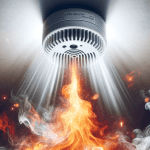
A false alarm is an alarm with no real fire behind it.
Most come from a few repeat causes: cooking fumes, dust or insects, construction dust, and detectors near HVAC vents.
An addressable system helps you find the cause faster.
A false alarm costs more than the evacuation itself. Each one erodes occupants’ trust in the system. Soon people say “it’s probably nothing again”, and a real system stops working as one.
The better fix is to find the cause. Then reduce it through design and system architecture. Asking occupants to be patient does not help.
Few false alarms come from a detector that fails at random. Most trace back to a small number of repeat causes:
Cooking fumes or steam that reach a detector sited too close to a kitchen.
Dust or insects in an optical chamber, especially in tropical, dusty areas.
Dust from construction work near detectors that nobody covered or moved.
A detector near an HVAC vent that draws in passing particles.
Less often, a wiring fault or a device at the end of its service life.
Steam and fumes also trigger alarms near break rooms and poorly ventilated bathrooms. A detector sited without allowing for normal, non-fire aerosols will eventually false-alarm on them.
Common cause
Practical fix
Cooking steam or fumes near a smoke detector
Move the detector away from the cooking area. Or use a heat detector such as FSH-001 in that spot.
Dust or insects in an optical chamber
Clean or replace the affected smoke detector. In dusty areas, inspect more often than the manufacturer’s default cycle.
Construction or renovation dust
Fit a temporary detector cover during the work. Remove it right after.
Detector near an HVAC vent
Move the detector away from direct airflow at the design stage.
Wiring fault or end-of-life device
Test the circuit. Replace the device. Do not reset the panel again and again.
Quick-reference summary of the causes above. It does not replace a qualified technician’s on-site diagnosis.
Why finding the cause matters more than resetting the panel
It is tempting to silence the alarm and move on. But a false alarm that repeats from the same device or area is a diagnostic signal.
If one detector keeps tripping, ask why. The cause may be the wrong detector type for the space, the wrong placement, or contamination that needs cleaning.
NOTE Treat each repeat as a pattern, not a one-off. Otherwise the building ends up with a detector that under-performs when it matters and over-triggers when it does not.
How an addressable system helps reduce false alarms
An addressable panel, such as FireSmart’s WCP-1, does not remove false alarms by itself. Its architecture makes them faster to diagnose and easier to reduce over time.
Each device on the network reports on its own, not only by zone. A facilities team can see which device triggered and how often. Over weeks or months, a pattern appears.
On a conventional system, a repeat offender hides among every other device in its zone. In an addressable history it stands out.
This also targets maintenance. After a false alarm, check the device that triggered first. Look for dust, insects or a placement problem. That is faster and less disruptive than inspecting the whole zone.
Placement and detector-type choices that reduce false alarms from the start
Many repeat false alarms can be avoided at the design stage:
Keep detectors an adequate distance from cooking equipment and steam sources.
Choose heat detection, not smoke detection, in spaces with routine dust, fumes or steam that are not fire-related (workshops, some kitchens, boiler rooms).
Cover detectors during construction or renovation work. Do not leave them exposed.
Follow the manufacturer’s stated environmental operating range. Do not install the same detector type in every space.
TIP Heat detection is often the right choice where steam or fumes are normal. Use it only where the design allows it.
The real cost of a false alarm
The visible cost is the interruption: production stopped, guests evacuated, staff pulled away from work for a drill that was not a drill.
The hidden cost builds up. After several false alarms, occupants move slower. They check their phones before leaving their desks.
They assume it is another glitch. That delay becomes dangerous the one time the alarm is real.
In some jurisdictions, repeated false alarms from the same address can also draw scrutiny or administrative penalties from the local fire authority.
None of this is a reason to under-react to alarms. It is a reason to fix the underlying cause, not treat each false alarm as a one-off nuisance.
Frequently asked questions
1️⃣ What is the single most common cause of false fire alarms?
Cooking steam and fumes near food preparation areas are among the most frequently reported causes. Dust or insects in smoke detector chambers come next, especially in tropical or dusty environments.
2️⃣ Does an addressable system stop false alarms from happening?
Not by itself. The underlying cause (placement, detector type, contamination) still has to be fixed. What a system like WCP-1 changes is visibility. Each device reports individually, so a repeat pattern from one detector is easy to spot and diagnose.
3️⃣ Should a detector that keeps false-alarming just be replaced?
Not as a first step. Check placement, contamination, and whether the detector type suits the space. Replacing the device without fixing the cause often just moves the same problem to the new unit.
4️⃣ Can construction or renovation work cause false alarms?
Yes. Dust from cutting, sanding or demolition is a common trigger if nearby detectors are not covered or moved. It is also one of the more preventable causes, because it is tied to a known, scheduled activity.
30-SECOND SUMMARY EN 54-25, ISO 7240-25 and TCVN 7568-25 are three labels for one requirement set for radio-linked fire alarm parts. “EN 54 compliant” is not the same as “EN 54-25 certified”. Four questions tell them apart. FireSmart does not hold EN 54-25 or ISO 7240-25 certification for the wireless line today. Quick answer: EN…
Berbeda cara alarm kebakaran tradisional, sistem alarm kebakaran nirkabel adalah solusi baru yang memanfaatkan teknologi nirkabel untuk mendeteksi dan memberikan peringatan tentang risiko kebakaran. FireSmart adalah perusahaan yang memproduksi perangkat alarm kebakaran di Vietnam. Kami memproduksi sistem alarm kebakaran nirkabel, termasuk panel kontrol pusat, detektor asap, detektor panas, sirine alarm, dan tombol tekan alarm darurat….
30-SECOND SUMMARY Fire load is the total combustible material in a room. Fire investigators use this term. Each material ignites at a different temperature and gives off different smoke and gases. Choose the detector type to match the dominant fuel in each room. A home rarely burns because of one single hazard. It burns because…
Alarm kebakaran tanpa wayar digunakan secara meluas di seluruh dunia dan di Malaysia kerana kemudahan dan keselamatannya. Berbeza dengan sistem alarm kebakaran tradisional, sistem alarm kebakaran nirkabel adalah penyelesaian baru yang menggunakan teknologi nirkabel untuk mengesan dan memberikan amaran tentang risiko kebakaran. FireSmart adalah syarikat yang menghasilkan peranti alarm kebakaran di Vietnam. Kami menghasilkan sistem…
1. Understanding Fire Alarm System Components In the realm of fire safety, the fire alarm system stands as a pivotal element, ensuring the safety and protection of both lives and property. A fire alarm system is an amalgamation of various components, each playing a crucial role in detecting and alerting occupants in the event of…