The real difference is how the panel identifies where a signal came from.
Conventional systems report a zone. Addressable systems report the exact device.
Choose by the least flexible constraint: budget, disruption or building fabric.
People ask “conventional or addressable?” as if it were a features list. The real difference is lower down: how the wiring and the panel identify where a signal came from.
That one choice affects installation cost, wiring layout, fault diagnosis and later expansion. This guide explains what each architecture does. It then shows which to specify for a given project.
Aspect
Conventional (zone)
Addressable (wired)
Addressable (wireless/hybrid)
Fault/alarm location precision
Zone-level (an area)
Device-level (the exact unit)
Device-level (the exact unit), same precision as wired addressable
Typical FireSmart panel capacity
FCP: 2–8 zones · FSP: 10–40 zones
Wired addressable loop, capacity per panel model
WCP-1: up to 160 addressable devices on one wireless loop
Devices per circuit
Up to 32 detectors per zone, reported as one group
Each device individually polled and addressed over cable
Each device individually polled and addressed over radio
Wiring requirement
Supervised EOL cable loop per zone
Supervised addressable cable loop (no zone segmentation)
Self-routing wireless network — no cable pull. Hybrid setups bridge wireless devices into a wired backbone where needed
Fault tolerance
A cut/shorted zone circuit raises a fault for the whole zone
A cut cable can disable the loop past the break point
Each device also relays for others, so one device’s radio fault does not take down the whole network
Best fit
Small-to-mid buildings, open-ceiling new construction, tight budget
Projects that want device-level identification and already have accessible cable pathways
A conventional system wires detectors and call points in groups called zones. Each zone lands on its own circuit at the control panel. FireSmart’s FCP covers 2 to 8 zones. The larger FSP range covers 10 to 40.
Each zone typically carries up to 32 detectors. The panel supervises the circuit with an end-of-line (EOL) resistor. If a wire is cut or shorted, the panel raises a fault. It does not stay silent.
When an alarm trips, the panel reports which zone activated. It does not report which detector.
NOTE A zone can cover a whole floor or a run of offices. The alarm then tells the response team only “somewhere in this area”. Confirming the exact device means walking the zone.
In a small building with a few zones, a technician checks a zone in a minute or two. This is rarely a problem.
In a large or subdivided building, verification is slower. One detector that often false-alarms is also harder to isolate remotely.
How an addressable system works
In an addressable system, every device on the loop has its own unique address. The panel polls each device individually. An alarm report names the exact detector or call point, not just its zone.
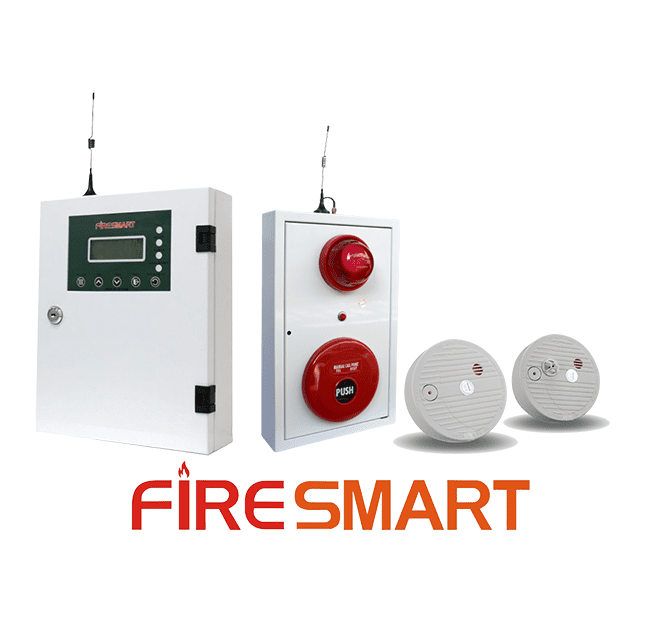
FireSmart’s WCP-1 is an addressable panel built around a wireless loop. It does not use a supervised cable loop. Each device talks over radio.
Every device in the network also acts as a repeater for the others. The network extends its own coverage as devices are added. It needs no separate signal boosters.
A single WCP-1 panel supports up to 160 addressable devices. You program them directly from the panel.
The wireless devices route signal to each other. A fault at one device’s radio link therefore does not take down the whole loop. A single cut wire can disable a conventional zone.
The panel still shows which exact device is in alarm, fault or low battery. This is the same precise identification as a wired addressable loop, without the cable pull.
Installation cost and building disruption
Wired conventional systems remain the most straightforward option where cable pathways exist. They also suit new construction where cabling is part of the build. Equipment cost per point is typically lower. The wiring is simple compared to an addressable loop’s cabling.
The trade-off appears where the wiring is the hard part. Examples are:
Existing buildings with finished walls and ceilings.
Heritage structures where cutting into original fabric is not acceptable.
Multi-building sites where trenching cable between structures is impractical.
On those projects, a wireless addressable system like WCP-1 removes the cable run entirely. This is why it appears more often on retrofit and heritage work than on ground-up new builds with open ceilings.
A third option sits between the two. A building can run a wired addressable loop: cable, with per-device addressing. It keeps the precise fault location of addressable. It still needs the wiring pull of a conventional system.
Choose it when the project wants device-level identification. Cable pathways must already be available and preferred over radio for that area.
A practical way to decide
The decision usually comes down to three questions. Ask them in this order:
Are cable pathways accessible? Or would running them mean cutting into finished or protected surfaces? If pathways are accessible and ceilings are open, wired conventional is usually the lowest-cost path for a small-to-mid-size building. This applies to new construction and major renovation.
How many zones or devices, and how important is exact fault location? A building with more than a handful of zones, multiple tenants or a history of nuisance alarms from one area benefits from per-device identification. That points toward addressable, wired or wireless.
Is the building occupied and finished, a heritage structure, or spread across several structures? Cable runs would be disruptive or impractical there. This is the case wireless addressable exists for.
TIP From field experience, device count alone rarely decides. The deciding factor is usually the constraint that is least flexible on that project: budget, disruption tolerance or building fabric.
Two examples show this:
A 40-zone warehouse has an open steel structure and no finish to protect. It can still make sense as conventional if the budget is tight and false-alarm troubleshooting is not a major concern.
A 6-zone shophouse mid-renovation has finished walls. It can make more sense as wireless addressable, even though the zone count alone suggests conventional is “big enough”.
Mixing architectures on one project
The two architectures are not mutually exclusive on one site. A common configuration uses a wired panel for the main building, where cable pathways exist.
Coverage then extends to outbuildings, annexes or a retrofit wing. A separate wireless addressable panel does this, or wireless devices bridged into the main system. It avoids a trench run between structures. Monitoring stays centralised.
NOTE Confirm the wiring and device count against the applicable local fire alarm design code before you finalise a layout. Zone sizing and device spacing limits vary by jurisdiction.
Frequently asked questions
1️⃣ Does an addressable system cost more than a conventional one?
Per-device equipment cost is typically higher for addressable hardware. Total installed cost depends heavily on wiring. On a retrofit project, wireless addressable can cost less overall once cable-pulling labour is counted. The panel and devices still cost more per point.
2️⃣ Can a conventional system be upgraded to addressable later?
Not by reprogramming alone. You must replace the panel, because conventional and addressable panels use different electronics to communicate with field devices. Existing wiring can sometimes be reused for a wired addressable upgrade. A switch to wireless addressable does not need the old wiring at all.
3️⃣ Does a wireless addressable system need a device within range of every other device?
No. Every device in the network also relays signal for the others. Coverage extends hop by hop across the building. Every device does not need to reach the panel directly.
4️⃣ How many devices can one FireSmart WCP-1 panel support?
Up to 160 addressable devices on one panel, programmed directly from the panel itself.
5️⃣ Is a wired addressable loop the same as a wireless addressable system?
No. Both give per-device identification. A wired addressable loop still needs a supervised cable run between devices. A wireless addressable system like WCP-1 replaces that cable with a self-routing radio network.
6️⃣ Can a single building use both wired and wireless addressable devices together (a hybrid setup)?
Yes. A common configuration bridges wireless addressable devices into a wired backbone for a specific wing, annex or outbuilding. A retrofit area then avoids a trench run. The rest of the building keeps its existing wired loop, and all of it reports to the same panel. See “Mixing architectures on one project” above for a typical layout.
30-SECOND SUMMARY Write how the system must behave and what each part must be certified against. Keep the two apart. Set ten clauses: link supervision, batteries, capacity and commissioning evidence matter most. Put eight questions to the manufacturer before you accept a tender. A specification is where a fire alarm project is really decided. By…
30-SECOND SUMMARY Video fire detection (VFD) analyses camera footage in real time to spot smoke or flame. Use it in zones where point detectors are slow: factory floors, timber and textile workshops, open-air yards. It works next to point detectors, not instead of them. Point-type smoke and heat detectors work well in most buildings. Some…
30-SECOND SUMMARY Size the sound level to the room: 10 dBA over ambient, and 75 dBA at the bed head in sleeping areas. Add a strobe where sound alone may not reach everyone, for example in very noisy spaces. Mount strobes about 2 m above the floor. Put every device on your routine test cycle….
30-SECOND SUMMARY Design in four steps: zoning, device schedule, calculations, approval package. Reviewers check two calculations: voltage drop and battery standby capacity. Submit all five documents together, with the same zone numbers in each. Outside the United States, many specifiers still use NFPA 72, the U.S. National Fire Alarm and Signaling Code. They use it…