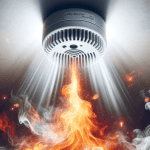
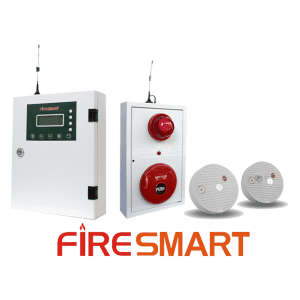
A tropical climate does not change the right technology. It raises the bar for sealing, drift compensation and cleaning.
Use photoelectric for general areas and heat detectors for kitchens, boiler rooms and garages.
Two detection technologies sit inside a smoke detector, and they respond to different fires. Ionization detectors react fastest to flaming fires with small combustion particles. Photoelectric detectors (also called optical, or light-scattering) react fastest to smoldering fires. Those fires make larger, visible smoke particles well before flame appears.
FireSmart builds its smoke-detection line around photoelectric technology. This guide explains why, and what it means for buildings in hot, humid climates.
A photoelectric detector has a small optical chamber. It holds a light source, typically an LED, angled away from a photosensor. In clean air, the light does not reach the sensor.
When smoke enters, particles scatter the light. Some of it reaches the photosensor. The detector reads this rise as smoke and raises an alarm once it crosses a calibrated threshold.
This light-scattering principle is used across the industry. Detector standards such as EN 54-7 and the detector chapter of NFPA 72 reference it. It is not a proprietary FireSmart mechanism. Chamber design, sensitivity calibration and drift compensation separate one manufacturer from another.
Why photoelectric suits smoldering fires
Smoldering fires burn without visible flame for minutes or hours. Examples are overheated wiring insulation, a cigarette in upholstery or a fault in an electrical panel. They release a steady stream of large smoke particles long before flame or heat is detectable.
Photoelectric detection responds strongly to these particles. It tends to catch smoldering conditions earlier than ionization does.
Many real fires in homes, hotel rooms, warehouses and offices start as smoldering events. So photoelectric is the common default for general area protection in modern guidance. Ionization is more often kept for places where fast-flaming fire risk dominates.
What a tropical climate changes
A tropical climate does not change which principle is correct. Photoelectric still responds fastest to smoldering fires. It raises the bar for build quality.
Sustained humidity, seasonal dust and insects are the three factors that most often cause nuisance alarms. A correctly chosen detector still fails if its chamber is not sealed and drift-compensated for the site.
Handling humidity, dust and tropical operating conditions
Hot, humid climates stress smoke detectors more than temperate ones. High humidity, seasonal dust and insects all affect an optical chamber over time. In many Southeast Asian buildings, insects enter any small dark cavity.
A detector without drift compensation can read contamination as smoke. Dust, condensation and insect debris then cause nuisance alarms, and these erode trust in the whole system. A detector with too much compensation can lose sensitivity instead.
FireSmart builds its optical detectors for this environment. The chamber is sealed to limit insect ingress. Drift compensation is tuned for the humidity range typical of the region, not for a temperate-climate baseline.
NOTE In dusty tropical buildings, an optical chamber that has not been cleaned for years is a common cause of “unexplained” false alarms. A scheduled cleaning cycle solves more nuisance-alarm complaints than re-calibration after the fact.
Photoelectric vs. ionisation in hot, humid climates
Factor in hot, humid climates
Photoelectric (optical)
Ionisation
Fastest at detecting
Slow, smoldering fires (common with overloaded wiring, overheated insulation)
Fast, flaming fires with small combustion particles
Sensitivity to humidity, steam and cooking vapour
Lower nuisance-alarm risk once drift-compensated for the region
Generally more prone to nuisance alarms from steam and cooking near the sensor
Dust and insect ingress (a real factor in many tropical buildings)
Manageable with a sealed chamber and a regular cleaning cycle
Same dust sensitivity, but nuisance alarms tend to be more frequent without compensation
Typical use in FireSmart’s line
Primary technology across wired (FSS-001) and wireless (WSD-1) smoke detectors
Not part of FireSmart’s current product line
Neither technology is universally “better”. This comparison is why FireSmart standardises on photoelectric for hot, humid, dusty conditions. It does not mix technologies by default.
Photoelectric smoke detectors vs. heat detectors
The table above compares detection technology for smoke detectors. A separate question matters in a hot, humid-climate project: when to specify a smoke detector, and when a heat detector.
Factor
Photoelectric (optical) smoke detector
Heat detector
What it senses
Visible smoke particles in the air, via a light-scatter chamber
A rise in ambient temperature past a fixed or rate-of-rise threshold
Best suited to
General living, office and storage areas, where early warning of a smoldering fire matters most
Kitchens, boiler rooms, garages and similar spaces where cooking fumes, dust or exhaust would set off a smoke detector
Nuisance-alarm risk in hot, humid, dusty conditions
Low once drift-compensated for the region; benefits from a periodic chamber cleaning cycle
Very low. Steam, cooking vapour, dust and insects largely do not affect it
FireSmart product line
FSS-001 (wired), WSD-1 (wireless)
Not part of FireSmart’s current standalone line. A combined smoke-and-heat unit covers both signals where a project needs it (see FAQ below)
TIP Default to photoelectric for general area coverage. Use heat detection only in rooms where a smoke detector would alarm on cooking fumes or exhaust. For the full decision, read FireSmart’s guide to choosing fire detectors for hot, humid climates.
FireSmart’s photoelectric line: wired and wireless
FireSmart offers photoelectric smoke detection in two architectures. They cover new-build wired installations, and retrofit or heritage projects where running new cable is impractical.
FSS-001: a conventional, zone-wired photoelectric smoke detector for FCP/FSP panel installations. It suits new-build and larger commercial projects where cable is part of the base build.
WSD-1: a wireless, individually addressable photoelectric detector for the WCP-1 mesh network. It suits retrofits, occupied buildings, and heritage or decorative interiors where chasing cable into walls or ceilings is not an option.
Both use the same photoelectric sensing principle. The choice between them is about wiring and project type, not detection technology.
Maintenance that keeps an optical detector accurate
Accuracy depends on two things. The optical chamber must be clean. The mounting position must be representative of the air the detector samples.
In tropical, dusty or humid environments, shorten the inspection interval below the manufacturer’s minimum baseline. Do a visual inspection and a functional test at each scheduled visit. Clean the chamber itself, not just the outside, whenever you find visible dust or insect debris.
Detectors near kitchens, workshops or loading areas need attention more often than detectors in clean office space. This holds for any model.
Frequently asked questions
1️⃣ Is photoelectric or ionization better for a typical home or office?
Photoelectric is the usual default for general area protection. It responds earlier to slow, smoldering fires, which are common in everyday settings. Ionization responds faster to some fast-flaming fires. It also gives more nuisance alarms from cooking and steam.
2️⃣ Do photoelectric detectors give more false alarms near kitchens or bathrooms?
They give fewer steam and cooking alarms than ionization detectors. Even so, no smoke detector belongs directly inside a kitchen or shower area. Keep the minimum distance from cooking appliances and humid fixtures, whatever the technology.
3️⃣ How often should an optical smoke detector be cleaned in a humid climate?
No single interval fits every site. It depends on local dust, insect activity and humidity. In tropical conditions, inspect and clean the chamber more often than a temperate-climate schedule suggests. Clean it at once if the detector reports intermittent or nuisance alarms.
4️⃣ What’s the difference between FSS-001 and WSD-1?
Both use the same photoelectric sensing principle. FSS-001 is a conventional, zone-wired detector for FCP/FSP panel installations. WSD-1 is a wireless, individually addressable detector for the WCP-1 mesh network. It suits retrofits and heritage buildings where new cable isn’t practical.
5️⃣ Can a photoelectric detector be combined with a heat detector in one unit?
Yes. Combined smoke-and-heat detection gives faster response to both smoldering and fast-developing fires in one device. Check the product’s detection principles before you specify it. A combined unit still uses the same photoelectric and thermal sensing methods, packaged together.
6️⃣ When should a heat detector be used instead of a photoelectric smoke detector?
Use a heat detector where the space itself would trigger nuisance alarms on a smoke detector. Examples are kitchens, boiler rooms and garages, with routine steam, cooking fumes, dust or exhaust. A heat detector responds to temperature rise, so these conditions do not affect it. The trade-off: it gives less early warning of a slow, smoldering fire in a normal living or office area.
Berbeda cara alarm kebakaran tradisional, sistem alarm kebakaran nirkabel adalah solusi baru yang memanfaatkan teknologi nirkabel untuk mendeteksi dan memberikan peringatan tentang risiko kebakaran. FireSmart adalah perusahaan yang memproduksi perangkat alarm kebakaran di Vietnam. Kami memproduksi sistem alarm kebakaran nirkabel, termasuk panel kontrol pusat, detektor asap, detektor panas, sirine alarm, dan tombol tekan alarm darurat….
30-SECOND SUMMARY Daily: do nothing, but know the normal LED blink (once every 40 seconds). Monthly: press TEST on each detector and check the chamber for dust. Battery: replace it when the low-battery beep appears, not on a fixed schedule. Every FireSmart WSD-1/WHD-1 detector has its own status LED. So does the FSMBL-001 sounder-strobe-call-point unit….
30-SECOND SUMMARY Video fire detection (VFD) analyses camera footage in real time to spot smoke or flame. Use it in zones where point detectors are slow: factory floors, timber and textile workshops, open-air yards. It works next to point detectors, not instead of them. Point-type smoke and heat detectors work well in most buildings. Some…
30-SECOND SUMMARY A false alarm is an alarm with no real fire behind it. Most come from a few repeat causes: cooking fumes, dust or insects, construction dust, and detectors near HVAC vents. An addressable system helps you find the cause faster. A false alarm costs more than the evacuation itself. Each one erodes occupants’…
30-SECOND SUMMARY Detectors are grouped by what they sense: smoke, heat or an infrared beam. Humidity, dust and insects do not change the correct detection principle. They change which detector build survives without nuisance alarms. Photoelectric smoke detectors suit most general spaces, heat detectors suit kitchens and plant rooms, and beam detectors suit large open…