Size the sound level to the room: 10 dBA over ambient, and 75 dBA at the bed head in sleeping areas.
Add a strobe where sound alone may not reach everyone, for example in very noisy spaces.
Mount strobes about 2 m above the floor. Put every device on your routine test cycle.
A fire alarm that detects a fire but fails to tell anyone has failed at its one job. Sounders and strobes are the bells, horns and flashing lights that alert people. They are often specified last and under-engineered first.
Placement, sound output and testing follow established principles. These appear in NFPA 72 (Chapter 18, notification appliances) and ISO 7240-3/7240-23 (sounders and visual alarm devices). This guide shows what we build into FireSmart’s own notification devices and how we design their placement. It is written for engineers and contractors working in tropical-climate buildings.
Why notification appliances need engineering, not guesswork
It is tempting to treat a fire bell as a simple accessory. Wire it to the panel, mount it somewhere convenient, done. In practice, three variables decide whether people notice and respond to an alarm:
Loudness: how loud the signal is relative to the background noise of the space;
Visual signal: whether a visual signal is present for occupants who cannot rely on hearing;
Condition: whether the device works when it matters.
Each of these is a design decision, not an afterthought.
Sound level: how loud is loud enough
A sounder’s rated output on a datasheet is only half the story. What matters is how that output compares to the ambient noise of the room it protects.
The design principle we build to is simple. The audible alarm signal must exceed the ambient sound pressure level by at least 10 dBA. Average this over a 60-second measurement window. Ambient conditions typically range between 65 dBA and 105 dBA.
In a sleeping area protected by a detector, the minimum is higher. The signal must reach at least 75 dBA at the bed head, with all bedroom doors closed.
FireSmart’s combined sounder-strobe, the FSBL-001, is rated at ≥90 dBA measured at 1 metre. That gives enough headroom for most industrial and commercial ambient noise levels. It does not replace measuring the actual space.
A sounder that is loud enough in an empty office can still be inaudible on a working factory floor. The same is true in a warehouse with reverse-beeping forklifts. Measure ambient noise on site before you finalise sounder count and placement. Do not rely on the datasheet number alone.
When you need a strobe as well as a sounder
A visual signal (flashing light or illuminated sign) alongside the sounder is not optional decoration. It is required wherever an audible-only signal cannot be relied on to reach everyone. The typical trigger conditions are:
Ambient noise regularly exceeds around 95 dBA, so the audible signal may not be reliably distinguishable;
The space is regularly used by people who are deaf or hard of hearing;
An audible alarm is deliberately restricted or muted for operational reasons, such as operating theatres, recording studios, and certain meeting or control rooms.
Outside these conditions, a sounder-only signal may be adequate. Pairing sounder and strobe in one device (as with FSBL-001) removes the guesswork. It also future-proofs the space if its use changes.
Strobe placement: height and spacing
A flashing light works only if every occupant in the protected area can see it. This makes placement, not just brightness, the variable that matters.
We design wall-mounted visual alarm devices to this guidance: mount at a minimum height of around 2 m from the floor. Space devices so that no gap between them exceeds roughly 45 m. No point in the protected area should be out of line of sight of a signal.
Exact figures vary by code and jurisdiction. Check your local fire alarm standard for the numbers that apply to your project. Do this especially where ceiling height, partitions or sightline obstructions affect coverage.
FireSmart’s strobe output (FSL-001 standalone, or combined in FSBL-001) is rated at 0.3 Lm. It has been measured clearly visible at 35 m under normal indoor conditions. Use this as a starting reference when you lay out spacing on a floor plan.
A site walk still matters more than the datasheet number. Look for obstructed sightlines: partitions, tall storage racking and structural columns.
Mounting and wiring
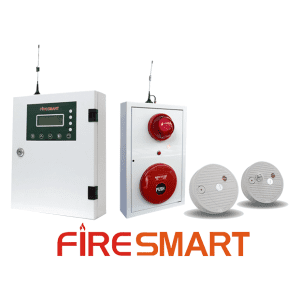
FireSmart sounders and strobes connect to the panel with a simple two-wire connection into the bell/notification circuit terminals. A conventional install needs no separate signal bus. Two mounting patterns are used in practice:
Direct wall mount: base plate fixed to the wall at the height noted above, then the cover closed over it. Typical fixing centres are 45–60 mm apart;
Combination box mount: the sounder/strobe is fitted into a combined bell-light-manual call point enclosure, next to a manual call point. This is common in corridors, stairwell landings and lobbies where one compact fixture must carry several notification functions.
FireSmart sounders and strobes pair with a conventional wired panel (FCP series) or with the wireless WCP-1 control panel. They can also be triggered as part of a monitored, multi-zone system alongside third-party detection equipment already on site.
NOTE Measure the 10 dBA rule against the ambient noise present during a fire, not a quiet Sunday morning. On a factory floor, test with production running. A sounder that clears the test at 7 a.m. can fail at 2 p.m. with three machines on.
Testing and maintenance
Test sounders and strobes in the same routine cycle as the detectors and panel. Each cycle should cover:
A visual inspection for physical damage, and for dust or paint overspray blocking the lens or grille;
A functional activation test. Confirm that both the audible and visual outputs fire when the zone is triggered;
A battery check for battery-backed or wireless notification devices, on the same cycle as the detectors they are paired with.
Where practical, test under conditions close to the space’s actual working noise level. Do not test only when the building is empty. The device has to perform in working conditions.
Frequently asked questions
1️⃣ What’s the difference between FSL-001 and FSBL-001?
FSL-001 is a strobe/indicator light only. FSBL-001 combines the strobe with a sounder rated at ≥90 dBA at 1 m. It covers audible and visual notification from one point. It is the more common choice for new installations.
2️⃣ Do I need a strobe if my building already has loud sounders?
Only if a trigger condition applies: high ambient noise, hearing protection, deaf or hard-of-hearing occupants, or restricted audible alarms. Otherwise a sounder-only signal can be adequate. Many projects now specify combined sounder-strobe devices as standard practice anyway.
3️⃣ How many sounders does a single room need?
It depends on the room’s ambient noise level and dimensions, not a fixed rule of thumb. Measure ambient noise on site. Confirm the sounder’s rated output clears it by at least 10 dBA. Add devices where partitions or equipment break the line of sound.
4️⃣ Can FireSmart sounders/strobes be wired into an existing third-party fire alarm panel?
In most cases yes, since they use a standard two-wire notification circuit connection. Confirm panel compatibility for the specific model before ordering. Check this first for supervised or addressable circuits.
5️⃣ How often should sounders and strobes be tested?
Put them on the same routine testing schedule as the rest of the system’s notification appliances. At each scheduled test, run a full functional test. Confirm both audible and visual output. A visual inspection alone is not enough.
This closes FireSmart’s series of seven technical guides on fire alarm design fundamentals for tropical-climate buildings. The series covers detector spacing, system design, operation, video detection, environmental selection, household fire loads and notification appliances. Read it from the start with the wireless fire alarm systems guide, or see FireSmart’s approach to certifications and compliance. For a specific project, talk to the manufacturer.
30-SECOND SUMMARY A false alarm is an alarm with no real fire behind it. Most come from a few repeat causes: cooking fumes, dust or insects, construction dust, and detectors near HVAC vents. An addressable system helps you find the cause faster. A false alarm costs more than the evacuation itself. Each one erodes occupants’…
30-SECOND SUMMARY Check that the supplier owns its production line. Ask what is certified today and what is only in progress. Confirm sampling, quality control and lead time before you sign. An OEM or private-label order is not a one-off purchase. You trust a factory’s production line, quality process and paper trail for every unit…
Alarm kebakaran tanpa wayar digunakan secara meluas di seluruh dunia dan di Malaysia kerana kemudahan dan keselamatannya. Berbeza dengan sistem alarm kebakaran tradisional, sistem alarm kebakaran nirkabel adalah penyelesaian baru yang menggunakan teknologi nirkabel untuk mengesan dan memberikan amaran tentang risiko kebakaran. FireSmart adalah syarikat yang menghasilkan peranti alarm kebakaran di Vietnam. Kami menghasilkan sistem…
30-SECOND SUMMARY FireSmart is starting research on early detection and fire response for electric vehicles in garages. The work covers sensing, fire-alarm integration, ventilation interfaces and response procedures. This is research, not a certified product or a compliance claim. Electric vehicles are now part of daily life. They park in apartment buildings, commercial premises, fleet…
30-SECOND SUMMARY Fire load is the total combustible material in a room. Fire investigators use this term. Each material ignites at a different temperature and gives off different smoke and gases. Choose the detector type to match the dominant fuel in each room. A home rarely burns because of one single hazard. It burns because…
30-SECOND SUMMARY Detectors are grouped by what they sense: smoke, heat or an infrared beam. Humidity, dust and insects do not change the correct detection principle. They change which detector build survives without nuisance alarms. Photoelectric smoke detectors suit most general spaces, heat detectors suit kitchens and plant rooms, and beam detectors suit large open…