Write how the system must behave and what each part must be certified against. Keep the two apart.
Set ten clauses: link supervision, batteries, capacity and commissioning evidence matter most.
Put eight questions to the manufacturer before you accept a tender.
A specification is where a fire alarm project is really decided. By the time tenders are compared, the clauses have already ruled out most options.
For wireless systems this matters more. Almost every template online was written by a manufacturer. A template built around one product family quietly becomes a single-source tender.
This is a working guide to the clauses that matter in a wireless or hybrid fire detection specification. It comes from the manufacturer’s side of the table. These are the clauses we are asked to answer, and the ones we most often find missing.
Why a wireless specification is not a wired specification with “radio” added
Three things change when detection moves off cable.
The radio link becomes a supervised part of the system. On a wired loop, a break is a fault. On a radio link, degradation is gradual. State how link quality is monitored and how often. State what the panel does when a device stops answering.
Batteries become a maintenance line item. A wired detector is powered by the loop. A wireless device carries its own energy budget. Put battery type, service life, low-battery annunciation and replacement access in the specification, not only in the O&M manual.
Device location becomes a radio problem as well as a coverage problem. Detector spacing still follows the design standard. The specification must also allow for a site survey and for repeaters. A lift shaft, a water tank or a metal-clad store can change the result after handover.
The two frameworks you will be asked about: NFPA 72 and EN 54 / ISO 7240
Most projects in Southeast Asia, South Asia and the Middle East follow one of two reference frameworks. Importers often have to answer both in the same document. State which one governs and which one is only referenced.
Topic
NFPA 72 (North American framework)
EN 54 / ISO 7240 (European and international framework)
Where wireless is addressed
Treated within the general requirements for initiating devices and their monitoring, not as a separate product standard.
EN 54-25 covers components that use radio links. ISO 7240-25 is the corresponding international part.
What the specification usually cites
Design, installation, inspection, testing and maintenance requirements.
Product conformity of individual components, part by part.
Practical consequence for a tender
You specify how the system must behave on site.
You specify what each component must be certified against.
The two are often mixed in one clause: “shall comply with NFPA 72 and be EN 54 certified”. That asks a supplier to meet a behaviour standard and a product-certification standard. It does not say which parts of the system each one covers.
Ten clauses that decide whether a wireless system fits the building
Scope and boundary. State which areas are wireless and which stay wired. Name who owns the interface between them.
Link supervision. State the supervision interval and the fault annunciation at the panel. State what happens when a device misses consecutive polls.
Redundancy of path. State whether mesh or repeated paths are required. Give the minimum number of independent routes from any device to the panel.
Radio environment. Require a frequency band permitted by the local telecommunications authority. Require the supplier to name the approval, not just the band.
Battery regime. State the battery chemistry, the service life at the stated ambient conditions and the low-battery warning threshold. State whether a battery can be replaced without removing the device from its base.
Standby power at the panel. State the standby and alarm durations. State whether the figures assume mains quality typical of the site.
Capacity and expansion. State the maximum devices per panel and per repeater. State the spare capacity required at handover, usually as a percentage.
Interfaces. State any required output to building systems, remote transmission or monitoring. Describe it as a function, not as a product name.
Commissioning evidence. Require a recorded link-quality figure for every device at handover. This one clause prevents most of the disputes that follow.
Maintenance access. State who may replace batteries and what tools they need. State whether a device can be exchanged without reprogramming the panel.
Clauses most specifications forget in a hot, humid climate
Templates written for temperate buildings carry assumptions that fail on a tropical site. For a hot and humid region, add the following.
Operating temperature and humidity range for the real installation position, not for an air-conditioned office. Panels are often installed in unconditioned service rooms. The range must hold there.
Condensation and ingress. Require an ingress protection rating for devices in car parks, plant rooms, loading bays and semi-open corridors.
Surge and lightning protection on mains and on any cabled interface, with the protection level stated. In many tropical regions this is the most common cause of equipment loss. It is almost never specified.
Extended mains outage. If grid interruptions of several hours are normal, say so. Size the standby for that, not for a default figure.
Construction dust. Require dust protection for devices fitted before fit-out ends. Or require detector heads to be fitted at a later, defined stage.
Battery life at elevated temperature. Suppliers quote battery life at a reference temperature. Require the life at the site’s design ambient. That is the number your maintenance budget will actually meet.
NOTE Specify where the batteries will be, not just how long they last. A 400-device retrofit with devices at eight metres in an operating warehouse costs far more to maintain than the same 400 devices in accessible corridors. The battery life figure is identical in both.
The same applies to panels. A control panel in an unconditioned riser in a tropical city works near the top of its stated range for most of the year. Put that in the specification, not in a site instruction after handover.
Questions to put to the manufacturer before accepting a tender
Which components carry which certifications? Can you supply certificates with certificate numbers, not a brand-level statement?
What is the supervision interval? What does the panel show between “device healthy” and “device lost”?
What link-quality figure is acceptable at commissioning? Will you record it per device?
What is the quoted battery service life, at what ambient temperature, and with what duty cycle?
Which frequency band will be used in this country, and under which local approval?
How many devices per panel and per repeater? What spare capacity remains in the proposed design?
If a device fails in year three, is it still available? Is programming kept on exchange?
Who performs the site survey? Is the survey result part of the offer by contract?
A short worked example: retrofit of an operating building
Take an occupied building where cable routes are not available. A typical configuration has these parts:
Wireless optical smoke detectors and heat detectors in rooms and corridors.
Wireless manual call points at exits.
Combined sounder-beacon devices on each floor.
Repeaters where a floor plate or a shaft breaks the path.
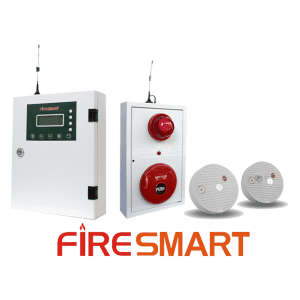
A wireless control panel with management software for monitoring and event history.
Write it as a typical configuration, not a product list. The specification then stays comparable between suppliers.
TIP Still deciding whether wireless suits the building at all? Our guide to wireless fire alarm systems covers that question before the specification stage.
Frequently asked questions
Is a wireless fire alarm system allowed under NFPA 72?
Yes. NFPA 72 does not require detection to be hard-wired. It sets requirements for how initiating devices are monitored and how faults are annunciated. A wireless system meets them through supervision of the radio link, not through loop continuity. This is why supervision clauses matter so much.
What does EN 54-25 actually cover?
EN 54-25 applies to components of a fire detection and alarm system that use radio links. It covers the behaviour and reliability of the link itself. It does not cover the detection principle of the device. The part for that device type covers it. ISO 7240-25 is the corresponding international part.
How should battery life be specified?
Specify three figures together: the expected service life, the ambient temperature it assumes, and the low-battery warning period before the device stops reporting. A single “five years” with no reference conditions is not comparable. In a tropical installation it is likely to be optimistic.
Can wireless and wired devices share one system?
In a hybrid design, yes. This is common in retrofits where part of the building is already cabled. State where the boundary sits. State how wireless devices appear on the panel beside wired loops. Name who is responsible for the interface. Commissioning disputes concentrate at that boundary.
What should a tropical-climate specification add?
Add these items.
Operating temperature and humidity at the real installation position.
An ingress protection rating for semi-open areas.
Surge and lightning protection with a stated level.
Standby sized for realistic mains outages.
Dust protection during fit-out.
Battery life restated at the site’s design ambient temperature.
Talk to the people who build the equipment
Are you drafting or reviewing a wireless fire detection specification for a hot, humid region? We can answer the eight questions above, including the conformity documents available for each component. Get in touch with our engineering team.
We are a Vietnamese manufacturer of wireless fire alarm equipment. We answer tender clauses written against both NFPA 72 and EN 54.
30-SECOND SUMMARY Design in four steps: zoning, device schedule, calculations, approval package. Reviewers check two calculations: voltage drop and battery standby capacity. Submit all five documents together, with the same zone numbers in each. Outside the United States, many specifiers still use NFPA 72, the U.S. National Fire Alarm and Signaling Code. They use it…
30-SECOND SUMMARY Test every part of the system on a fixed cadence: weekly, monthly, quarterly and annually. A passing self-test does not prove the alarm message reaches the monitoring centre. Log every visit. A test that is not logged did not happen, for compliance. Operating a fire alarm system and maintaining it are two different…
30-SECOND SUMMARY Daily: do nothing, but know the normal LED blink (once every 40 seconds). Monthly: press TEST on each detector and check the chamber for dust. Battery: replace it when the low-battery beep appears, not on a fixed schedule. Every FireSmart WSD-1/WHD-1 detector has its own status LED. So does the FSMBL-001 sounder-strobe-call-point unit….
30-SECOND SUMMARY Check that the supplier owns its production line. Ask what is certified today and what is only in progress. Confirm sampling, quality control and lead time before you sign. An OEM or private-label order is not a one-off purchase. You trust a factory’s production line, quality process and paper trail for every unit…
30-SECOND SUMMARY Fire load is the total combustible material in a room. Fire investigators use this term. Each material ignites at a different temperature and gives off different smoke and gases. Choose the detector type to match the dominant fuel in each room. A home rarely burns because of one single hazard. It burns because…