
A single factory building is a fairly ordinary fire-alarm design problem — the harder version shows up as a business grows into a second production hall, a third warehouse, or a plot inside an industrial park shared with other tenants. Machinery heat, oil mist, welding sparks and dust make many production floors unsuitable for smoke detection alone, and a site that is really several buildings — sometimes under one owner, sometimes several independent tenants inside the same park — needs a way for one management office to see every building’s fire status without walking the whole compound.
Why factories and industrial parks are different from a single commercial building
Three conditions shape the design. First, the production floor itself: welding, curing ovens, compressors and general machinery heat produce enough ambient heat, smoke-like particulate or oil mist to false-alarm an optical smoke detector under normal operation, which is why heat detection is the default over most of a working factory floor, with smoke detection reserved for offices, warehouses of finished goods, and other genuinely clean areas. Second, expansion: factories rarely reach final size on day one — a second production hall or a warehouse extension is a common addition, and whatever fire-alarm design is chosen has to extend to a new building without re-engineering the whole site. Third, industrial parks specifically often have several independently operated factory units on one plot, each responsible for its own fire alarm compliance, while the park’s management office still wants visibility of every unit’s status for its own emergency response and insurance requirements.
Typical configuration by site structure
The configurations below use FireSmart’s own product line as typical starting points, not a fixed specification. A qualified fire-alarm designer should still size zoning, detector type and cause-and-effect logic to the actual production process, stored-materials risk and local code.
Single factory building, one production hall plus office/warehouse
An FSP-8L panel zones the building by function: FSH-001 rate-of-rise heat detectors cover the production floor itself, where machinery heat and process fumes rule out smoke detection, while FSS-001 optical smoke detectors cover the office block and finished-goods warehouse. FSM-001 manual call points and FSBL-001 sounder-strobes sit at every production-floor exit, loud enough to be heard over machinery noise. A single FCOM-1 carries alarm and fault status to the monitoring point or fire department line.
Multi-building factory campus under one owner (production hall, warehouse, dormitory or office block added over time)
Each building typically keeps its own panel sized to its own use — a production hall on FSP-8L with heat detection, a warehouse or office block on a smaller FCP with mixed heat/smoke coverage. Where a newly added building cannot be cost-effectively cabled back to an existing panel — a common case when a factory expands onto an adjoining plot — a WCP-1 wireless addressable panel covers the new building instead, with every device also acting as a repeater so the network reaches across a larger footprint without a separate repeater infrastructure. Routing every building’s FCOM-1 to one shared monitoring account gives the site’s own safety office a single view of every building’s status.
Industrial park with several independently operated tenant factories
Each tenant factory is still responsible for its own panel and detection design sized to its own process risk — one tenant’s textile-cutting floor and another’s metal-fabrication floor call for different detector placement even inside the same park. What an industrial park’s management office typically wants on top of that is aggregated visibility: each tenant’s FCOM-1 (or FCOM-2 where a tenant runs a standalone system with no central panel) reporting to a shared monitoring account lets the park’s own emergency-response team see which unit has raised an alarm or a fault, without needing access to every tenant’s individual panel. This is a monitoring-layer arrangement on top of each tenant’s own compliant system, not a replacement for it.
Case study: FireSmart wireless fire alarm system at a Samsung facility, Yên Bình Industrial Park (Thái Nguyên, September 2026)

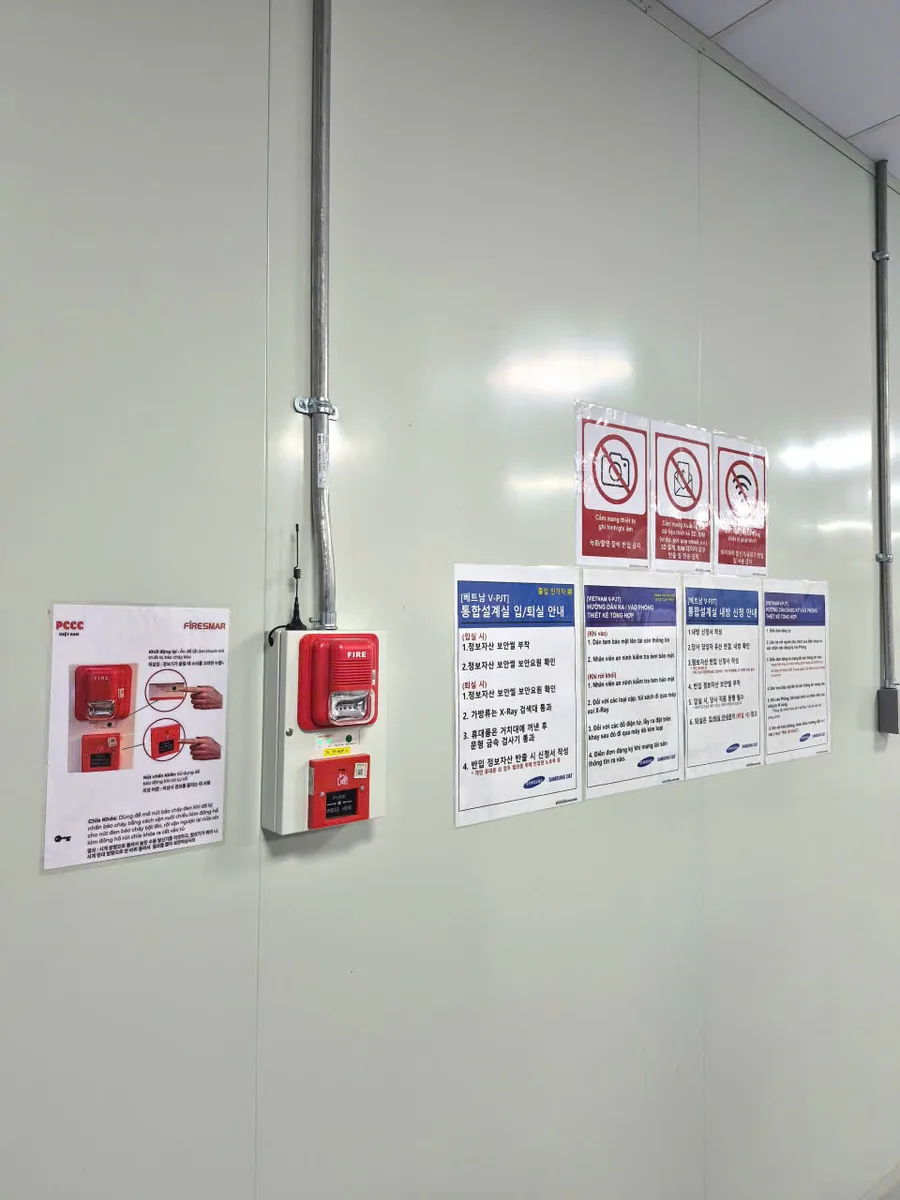
In September 2026, FireSmart installed a wireless fire-alarm system inside a Samsung facility in Yên Bình Industrial Park, Thái Nguyên province — an active, already-built industrial site of exactly the kind the “impractical to cable back to an existing panel” case above describes. The photos in this section are from that installation.
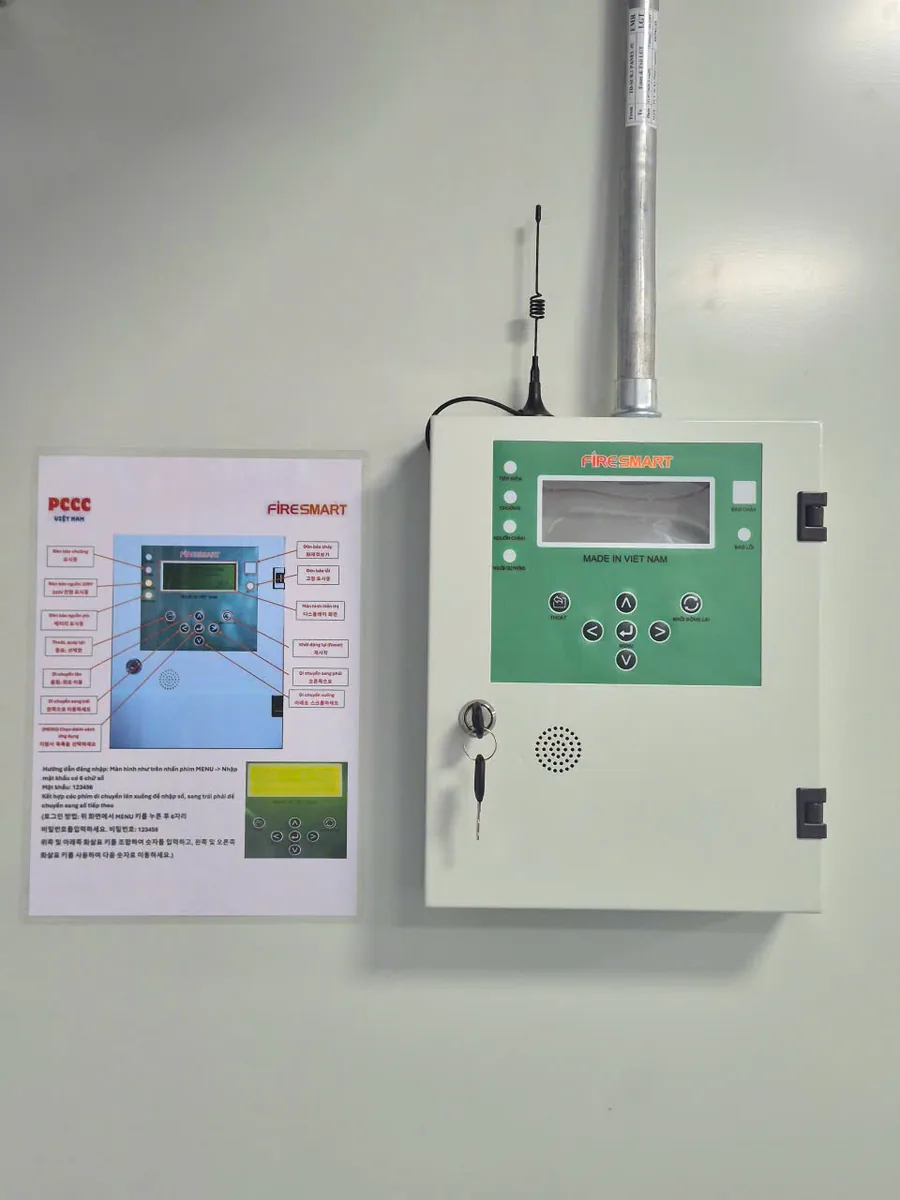
The panel on site is a WCP-1 — the same wireless addressable panel this page’s “multi-building factory campus” configuration above describes. Every detector, sounder-strobe and manual call point on its network is battery-powered and communicates with the panel by radio rather than a hard-wired signal loop, which is why the installation could proceed inside an operating facility without opening walls or running new cable trays along the production floor.
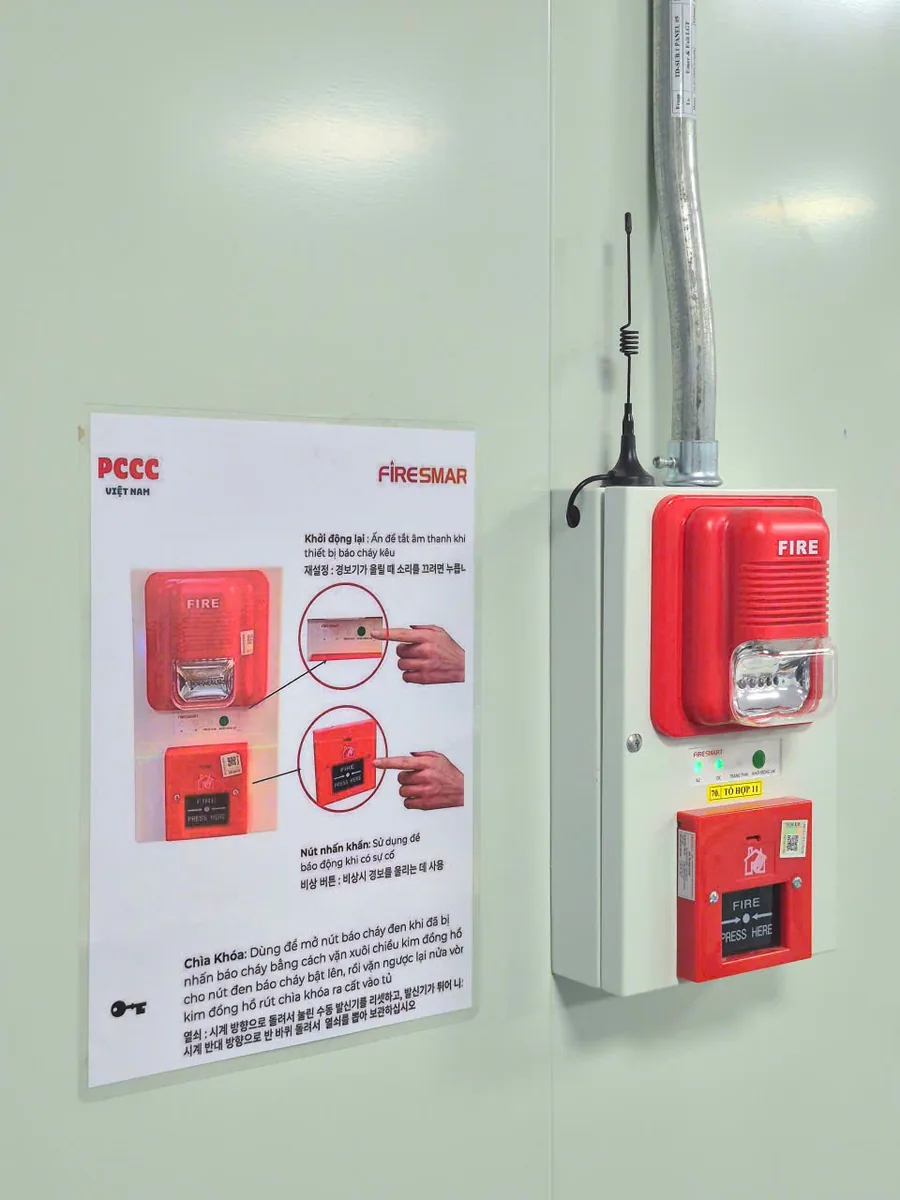
On this site, every wireless device’s antenna is raised on a short length of conduit clear of the false-ceiling grid and structural steel nearby — the same siting practice the FAQ below on radio range in a metal-heavy structure describes. A laminated bilingual (Vietnamese/Korean) instruction card is fixed beside each unit, showing how to silence and reset the sounder and how to use the manual call point.

Combo units are positioned along corridors and near exits throughout the facility, each paired at floor level with a cabinet of portable extinguishers — consistent with the “match detector type and device placement to the actual site, area by area” guidance in the checklist below.
Installation & commissioning checklist
- Match detector type to the actual production process, area by area — walk the floor with the process owner, not just the building drawings, since a curing oven, welding bay or compressor room needs heat detection even inside a hall that is mostly clean assembly work.
- Plan panel capacity for the next expansion, not just current floor area — an FSP-8L sized with headroom, or a wireless building added later, is cheaper than replacing an undersized panel once a second production line goes in.
- Test end-of-line supervision on every zone — long cable runs across a production floor with overhead cranes, forklifts and heavy equipment movement are more exposed to accidental cable damage than a finished office ceiling.
- Verify cause-and-effect logic against the actual process hazard (e.g. shutting down a specific line, releasing a smoke curtain, or isolating gas supply to one zone) rather than a generic default, and document it for the local fire authority’s review.
- Confirm the FCOM transmission path end-to-end to the monitoring point or fire department line, not just that the panel sounds locally on the factory floor.
- In a multi-tenant industrial park, agree the monitoring account’s alarm-labelling convention before commissioning — the park’s emergency-response team needs to know which tenant unit and zone raised the alarm, in a format everyone reads the same way.
- Hand over the event log, zone map and detector-type rationale to the factory’s own safety officer, so future line changes are checked against the existing detection design instead of guessing.
Before the factory is finished, the same wireless approach protects the building while it is still under construction — see wireless fire alarm for construction sites.
See also: Fire alarm systems for warehouses and logistics centres.
Frequently Asked Questions
Why do factory floors mostly use heat detectors instead of smoke detectors?
Welding, curing ovens, compressors and general machinery generate heat, fumes and particulate that would trigger frequent false alarms on an optical smoke detector during normal operation. A rate-of-rise heat detector like the FSH-001 responds to the temperature rise of an actual fire without reacting to routine process heat, and smoke detection is reserved for genuinely clean areas such as offices and finished-goods storage.
Can an industrial park’s management office monitor several independently operated tenant factories from one place?
Yes, at the monitoring layer — each tenant keeps its own compliant fire-alarm panel and design, and routing each tenant’s FCOM transmission device to a shared monitoring account lets the park’s emergency-response team see every unit’s alarm and fault status without accessing individual tenant panels directly.
Is a wireless system suitable for a factory floor with heavy machinery and metal structures?
A WCP-1 wireless addressable panel is most often used for a newly added building or a section that is impractical to cable back to an existing panel, with a site survey deciding device placement, since reinforced structures and dense metal equipment can affect radio range; a mesh network where every device also relays for its neighbours reduces the impact of any single obstruction.
How does a factory fire-alarm system scale when a second production hall is added?
The new hall typically gets its own panel — an FCP or FSP-8L if cabling is practical, or a WCP-1 wireless panel if it is not — with its FCOM device added to the same shared monitoring account as the existing building, rather than re-engineering the original system.
Does FireSmart supply gas-shutoff, smoke-curtain or sprinkler equipment for a factory’s cause-and-effect sequence?
No — FireSmart’s FCP and FSP panels provide the outputs and programming logic to trigger such equipment on an alarm; the gas-shutoff valves, smoke curtains or suppression equipment themselves are specified and supplied separately as part of the site’s fire strategy.
Has FireSmart installed a wireless fire alarm system at a real factory in Vietnam?
Yes. In September 2026, FireSmart installed a WCP-1 wireless fire-alarm system — including wireless sounder-strobe-and-manual-call-point combo units and wireless detectors — inside a Samsung facility in Yên Bình Industrial Park, Thái Nguyên province. Photos from that installation are in the case study above.
For the network, battery and standards questions that apply across FireSmart’s wireless product line, see the Wireless Fire Alarm Systems guide, including how FireSmart configures equipment for a tropical climate — relevant for most factory and industrial-park sites in this region. For the certifications and country-specific compliance status behind these products, see Certifications & Compliance. To talk through a configuration for a specific site, contact FireSmart.



