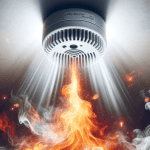
FireSmart is starting research on early detection and fire response for electric vehicles in garages.
The work covers sensing, fire-alarm integration, ventilation interfaces and response procedures.
This is research, not a certified product or a compliance claim.
Electric vehicles are now part of daily life. They park in apartment buildings, commercial premises, fleet depots and enclosed car parks. This brings clear benefits. It also raises new questions for building owners, facility managers, fire-safety professionals and emergency responders.
One question matters most. How can we detect an abnormal battery event as early as possible, before it becomes a severe incident? Such an incident can affect occupants, nearby vehicles, property and business continuity.
FireSmart is therefore starting a focused research initiative on early detection and fire-response solutions for electric vehicles in garages. We will study how sensing, fire-alarm integration, ventilation interfaces and response procedures can work together in a garage.
We do not claim that any single device can remove the risks of lithium-ion batteries. Our aim is to build an evidence-based view of the available technologies, their limits and the conditions in which they can support a safer response.
Lithium-ion battery failures are complex. A battery may overheat, develop an internal fault, release gas and smoke, ignite, or enter thermal runaway. The signs, their order and the available response time vary widely. Battery chemistry, state of charge, failure mechanism, vehicle design and ventilation all play a part.
In a garage, the challenge is wider than the vehicle itself. A response concept must consider the following points:
the enclosed or semi-enclosed space, parking layout and ceiling height;
air movement and access for responders;
protection of neighbouring vehicles;
false-alarm risk, drainage and maintenance;
compatibility with existing fire-protection systems.
For this reason, FireSmart treats the subject as a system problem. We are not looking for a single “EV fire sensor” or a single extinguishing method.
Areas of investigation
The research starts with four technical areas.
1. Early-warning signals of abnormal battery behaviour
We are reviewing signals that may appear before, during or after the start of a battery incident. They include:
electrolyte vapour and other volatile organic compounds (VOCs);
hydrogen, carbon monoxide and other relevant gases;
smoke and aerosol particles;
abnormal temperature rise and thermal patterns;
infrared or visible-camera indicators, where appropriate;
acoustic or electrical indicators, where accessible and reliable.
The key question is not whether a laboratory can detect a signal. It is whether a real garage can detect it reliably, with few false alarms and in time to act.
2. Sensors, modules and integrated monitoring systems
FireSmart is assessing single sensing elements, packaged modules and complete monitoring systems. The review covers gas and VOC sensors, multi-gas detectors, off-gas monitoring systems, and temperature and smoke detection. It also covers communication interfaces such as relay, analogue, CAN and networked outputs.
We focus on the traits that decide whether a technology can move from a test bench to a safe, maintainable installation:
sensitivity, selectivity and cross-sensitivity;
calibration needs and drift;
contamination tolerance and operating temperature;
diagnostics, enclosure design and mounting options;
long-term service requirements.
3. Integration with fire detection, ventilation and response systems
An early-warning signal is useful only when it leads to a clear and proportionate response. We will study how detection signals could connect to existing building systems. These include fire-alarm control equipment, mechanical ventilation or smoke control, notification arrangements, CCTV, access control and emergency procedures.
NOTE Ventilation changes how gas and smoke move and dilute. It does not replace control of a battery thermal event. An alarm signal must also link to an operational plan that covers verification, escalation, evacuation and responder access.
4. Practical deployment in new and existing garages
Many sites need retrofit options, not new infrastructure. We will consider concepts at parking-bay level and at zone level. The study covers sensor placement, sampling paths, cable routing, coverage, maintenance access and interfaces with existing fire-alarm systems.
The research will compare two approaches. Near-battery or near-vehicle sensing may be more sensitive, but it is hard to deploy across mixed fleets. Garage-area detection may scale better, but dilution, air movement and background contaminants affect it.
Our research principles
FireSmart follows five principles.
Evidence before claims. We separate supplier information, laboratory findings, independent test evidence and performance proven in a representative garage. A product claim is not a design requirement without supporting evidence.
Safety and responsible testing. We will not run hazardous battery-abuse or thermal-runaway tests without suitable facilities, an approved safety plan, qualified staff and clear emergency arrangements. Early phases prioritise literature review, system analysis, non-destructive evaluation and capable testing partners.
No premature certification statements. This is research and development. It is not a certified product, an approved installation method or a declaration of compliance with any code or standard.
System-level thinking. Detection, notification, ventilation, suppression, emergency response and recovery have different roles. A credible solution states these interfaces and its residual risks.
Fit for local application. International experience is valuable. A solution for Vietnam must still be evaluated against local building types, operating practices, regulations, service capability and project requirements.
Collaboration with technology providers and research partners
FireSmart welcomes technical talks with manufacturers, distributors, laboratories, universities, fire-safety specialists and facility operators. We are especially interested in:
sensor and module specifications, detection principles and known interferents;
test methods, validation data and limits of published performance claims;
application guidance for enclosed parking, charging rooms, depots and battery-energy-storage sites;
availability of evaluation units, technical documents and regional support;
routes for bench testing, demonstration projects and independent validation.
At this stage, discussions support research, technology assessment and responsible concepts. They are not a commitment to purchase, exclusivity, product approval or a commercial partnership.
Supporting similar research abroad
FireSmart is glad to support comparable research elsewhere. Your team may be working on a similar initiative in another market. If you need local context on Vietnam, we can help. This includes regulatory background, building and installation practices, and introductions to local manufacturers, distributors and testing facilities.
Looking ahead
The first output will be a structured technology and evidence map. It will cover early-warning indicators, sensor options, integrated monitoring systems and their possible interfaces with garage fire-safety measures. Later phases may develop selected system concepts and verification plans. They depend on available evidence, suitable partners and the necessary safety approvals.
We believe the most valuable outcome is a practical decision framework. It should show what a proposed technology can detect, what it cannot detect, how fast it may give useful information and what action should follow. FireSmart will share high-level updates as the research progresses.
Contact
For technical discussion, research collaboration or information about this initiative, please contact FireSmart.
30-SECOND SUMMARY Check that the supplier owns its production line. Ask what is certified today and what is only in progress. Confirm sampling, quality control and lead time before you sign. An OEM or private-label order is not a one-off purchase. You trust a factory’s production line, quality process and paper trail for every unit…
30-SECOND SUMMARY NFPA 72-2025 makes cybersecurity a mandatory chapter and adds two new detector types. Above a 40-foot ceiling, detector spacing now needs a performance-based design. Trouble signals for a failed communication pathway are due within 200 seconds. NFPA 72 is the U.S. National Fire Alarm and Signaling Code. It is revised every three years….
Berbeda cara alarm kebakaran tradisional, sistem alarm kebakaran nirkabel adalah solusi baru yang memanfaatkan teknologi nirkabel untuk mendeteksi dan memberikan peringatan tentang risiko kebakaran. FireSmart adalah perusahaan yang memproduksi perangkat alarm kebakaran di Vietnam. Kami memproduksi sistem alarm kebakaran nirkabel, termasuk panel kontrol pusat, detektor asap, detektor panas, sirine alarm, dan tombol tekan alarm darurat….
30-SECOND SUMMARY Fire load is the total combustible material in a room. Fire investigators use this term. Each material ignites at a different temperature and gives off different smoke and gases. Choose the detector type to match the dominant fuel in each room. A home rarely burns because of one single hazard. It burns because…
30-SECOND SUMMARY Design in four steps: zoning, device schedule, calculations, approval package. Reviewers check two calculations: voltage drop and battery standby capacity. Submit all five documents together, with the same zone numbers in each. Outside the United States, many specifiers still use NFPA 72, the U.S. National Fire Alarm and Signaling Code. They use it…